
MAC Welding and Fabrication Project Lessons from Mississippi: A Workforce-First Welding Model
Authored by:
Ann Avary, Director, Center of Excellence for Marine Manufacturing & Technology
Sarah Patterson, Workforce Development Director, AGC Education Foundation
Lindsey Williams, Dean, Workforce, Transfer and Trades, Walla Walla Community College
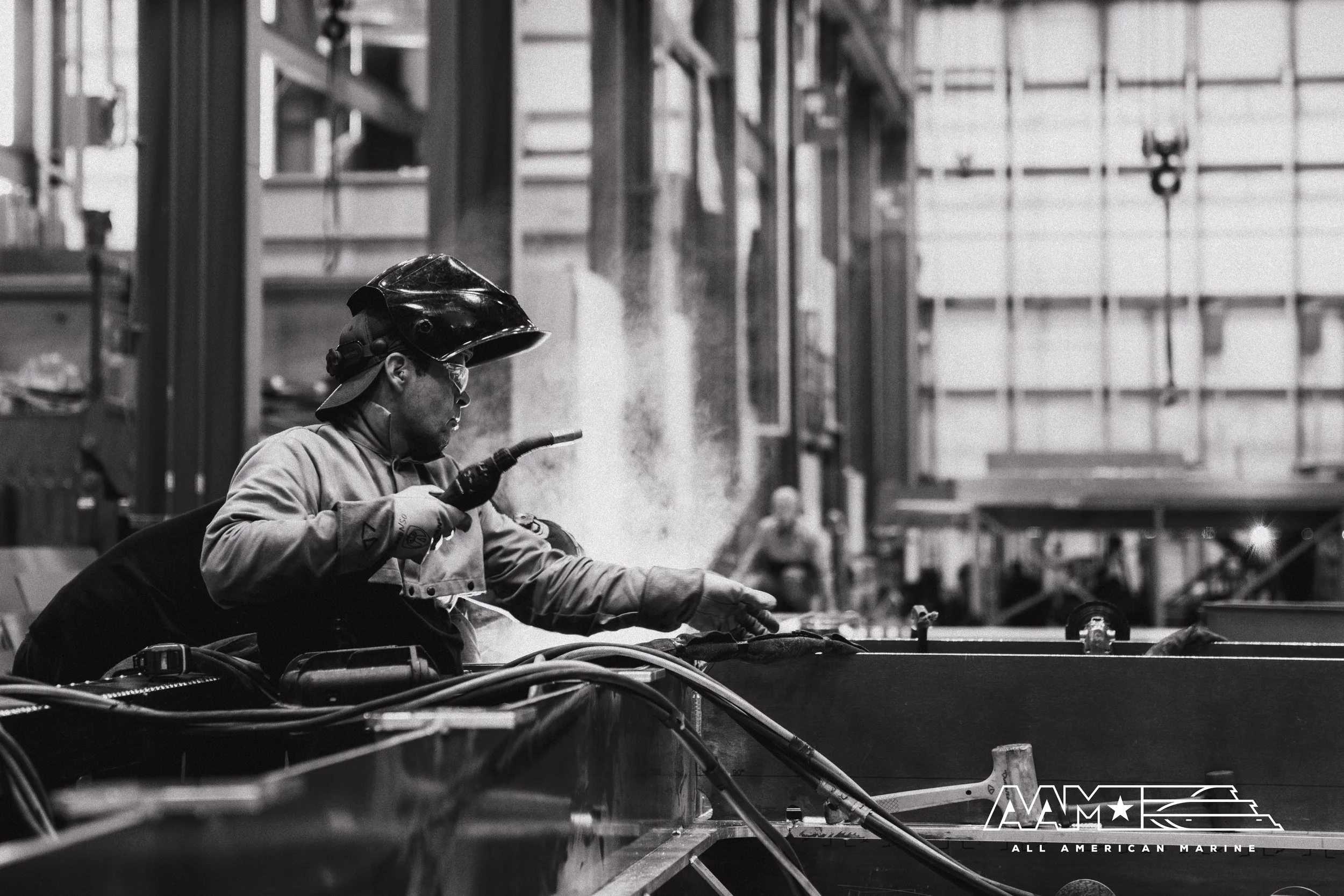
Photo courtesy of All American Marine
In late April, the MAC Welding & Fabrication Project leadership team - Lindsey Williams, Sarah Patterson, and Ann Avary - traveled to longtime partner Mississippi Gulf Coast Community College (MGCCC) for a two-day outreach and benchmarking visit focused on the college’s non-credit and credit-bearing welding programs and their direct alignment with Gulf Coast shipbuilding and industrial workforce demand.
We owe the entire team at MGCCC a huge debt of gratitude. They gave us two full days of their time, opened doors to industry partners, and gave us a front row seat to what high-functioning, industry-aligned welding workforce development actually looks like in practice.
Perhaps most impressive is the program’s direct connection to employment. Students in the non-credit pathway can earn up to four American Welding Society certifications before going directly to work at major employers including Bollinger Shipyards, Huntington Ingalls Industries, and other industrial employers throughout the region.
Over the course of two days, we met with faculty, workforce leaders, administrators, and industry partners to better understand how MGCCC has built a system that meets students where they are while also responding directly to workforce demand. A few things stood out immediately: speed to employment, embedded industry credentials, strong employer partnership, and a very clear focus on workforce outcomes.
The visit reinforced something important: this is an area where Washington State can take a page from the Mississippi playbook.
Too often, workforce development conversations focus on international models and global benchmarking exercises. While there is value in understanding what other countries are doing, executing at a high level does not always require sending delegations overseas to study workforce systems. In many cases, we need only look right here within the United States. There are states and institutions already building highly effective, industry-aligned workforce systems that are producing real results at scale. States can, and should, learn from one another.
MGCCC has built a welding workforce system that is fast, practical, accessible, and deeply connected to industry need. Their accelerated non-credit welding program is just 15 weeks long and offered at no cost to the student. That matters. It removes barriers and creates a direct pathway into family-wage careers supporting shipbuilding, repair, fabrication, and industrial manufacturing.
Nine Core Insights
1. Mississippi is solving an employer problem - MGCCC is not just offering welding training because welding is a useful skill. They are responding to a clear regional labor-market need. Shipyards and industrial employers need welders, so the college built a practical, credential-connected route into those jobs that also matches the speed of industry. That is the part Washington needs to pay attention to.
2. The speed matters - A 15-week, no-cost, non-credit program tied directly to employment is not a small detail. That is the model. Not every workforce need requires a two-year degree, a long pathway map, a new governance structure, or a multi-year planning process. Sometimes the right answer is a short, high-quality training program that gets people employable quickly, and allows for on the job learning with promotion potential.
3. Non-credit workforce training should not be treated as second-class, especially with Workforce Pell coming online - Washington still tends to privilege credit-bearing education and academic pathways, even when employers need faster skill development and students need a quicker path to income. MGCCC shows that non-credit training can be rigorous, valuable, industry-recognized, and directly connected to good jobs. If Workforce Pell becomes just another way to force short-term training into traditional academic structures, we will miss the point.
4. No-cost training is a workforce strategy, not a nice extra - If the goal is to move people into welding careers quickly, cost cannot be the barrier. That matters for rural students, adult learners, underemployed workers, displaced workers, and people who cannot afford to explore training options with their own money. Welding represents high-wage outcomes, but students frequently must begin in lower-wage roles that are not financially sustainable without or additional supports.
5. Industry credentials are embedded, not decorative - The AWS certifications matter because they give students portable proof of skill before they ever sit for an interview. That is different from completing a course and hoping an employer understands what it means. The credential, the training content, and the employer expectation are lined up from the beginning.
6. Employer connection is operational, not advisory - This is a big one. Lots of programs have advisory committees. That does not mean they are meaningfully connected to employers. The Mississippi model appears to have employers built into the actual talent pipeline. That is different from inviting industry to a quarterly meeting, asking them to review a framework, and calling it partnership.
7. Washington does not need to invent everything - We have a habit of creating new initiatives, new tables, new acronyms, and new pilot programs. MGCCC is a reminder that we should spend more time adapting working models and less time designing new concepts from scratch.
8. If Washington is serious about maritime workforce development (or really ANY industrial development), welding has to be treated as core infrastructure - Welding is foundational to shipbuilding, ship repair, fabrication, industrial maintenance, and port-adjacent manufacturing. MAC Welding should be framed as part of the industrial base strategy, not just as another education program. Let’s not forget – these skills are highly transferable. Maritime is a large welding employer, as are agriculture and construction, and the list beyond is long. Building professional welders without sector constraint is the end game.
9. Workforce Pell should stay focused on fast, practical, employment-connected training - This is the timely policy hook. Workforce Pell is supposed to open the door for short-term training that helps people move into real jobs more quickly. The Mississippi model is exactly the kind of example Washington should be studying as that conversation moves forward. The danger is that we take a flexible workforce tool and bury it under the usual process: credit conversion, governance conversations, pathway mapping, committee review, and institutional comfort. The point should be speed, access, employer alignment, and employment outcomes. MGCCC is a useful example because the program is not trying to look like a traditional college pathway. It is trying to get people trained, credentialed, and hired.
As we continue scaling the MAC Welding & Fabrication Framework and advancing the broader vision of Washington State as a Maritime Campus, the MGCCC model offers important insight into what scalable, industry-aligned welding workforce development can look like in practice.
The workforce demand is here now. Shipyards and manufacturers need skilled welders today. What MGCCC demonstrates is that when education, workforce development, and industry are aligned around a shared objective, it is possible to move people quickly into high-quality careers while strengthening the broader maritime industrial base at the same time.
Learn more about the MAC Welding & Fabrication Project at www.TeachWelding.org.