
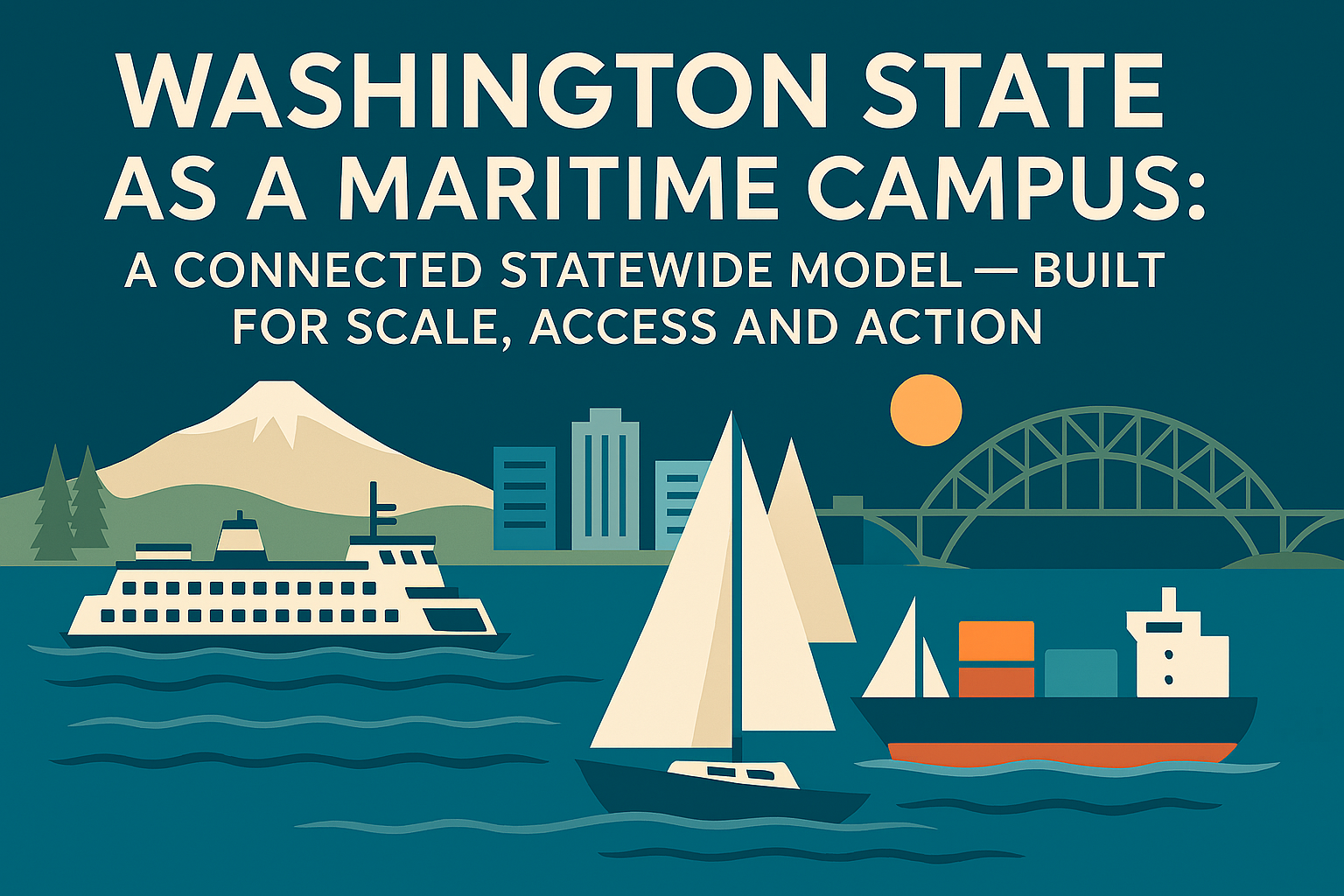
Washington State as a Maritime Campus: A Connected Statewide Model – Built for Scale, Access, and Action
By Ann Avary
April 6, 2026
Over the past couple of years, I’ve spent a lot of time talking with colleagues across industry, ports, education, economic and workforce development, and community organizations around a simple idea: What if we started thinking about Washington not as a collection of separate maritime efforts - but as a connected statewide campus?
Not a new institution. Not a new bureaucracy. And not a restructuring of the work already underway. Just a better way to see, and connect, what already exists.
At its core, this is straightforward. If we’re serious about expanding awareness, access, and workforce opportunity across Washington, we have to move beyond isolated programs and operate as a working network across the state.
The assets are already here. The opportunity is to leverage them – intentionally. This isn’t theoretical. Across the state, elements of this model are already in motion - some by design, others organically. What’s changed is that those efforts are starting to align.
The challenge now isn’t proving the concept. It’s making it visible and connecting it in a way that actually works.
The response to this concept has been positive. There are still questions, of course, and that’s a good thing. If it were easy, we’d already be there.
Starting at the Scale of the Challenge
The challenges we’re working on - awareness, access, workforce alignment - aren’t local. They’re statewide. Industry demand crosses regions. Pathways already operate at that level. Opportunities should too.
The Bigger Backdrop: Maritime Action Plan & Maritime Industrial Base
There’s a bigger context sitting behind all of this—and it matters. At the national level, the White House Maritime Action Plan is putting a very clear stake in the ground: we need to scale maritime capacity in the United States. Not incrementally. At scale.
That directive isn’t coming out of nowhere. It’s a direct response to the condition of the Maritime Industrial Base.
The Maritime Industrial Base is the real-world system—shipbuilding, repair, vessel operations, ports, suppliers, and the workforce that powers all of it. And right now, that system is under pressure. Demand is up across defense and commercial sectors. Capacity is tight. And workforce gaps are not a future issue—they’re already limiting throughput today. That’s the backdrop.
The Maritime Action Plan calls for three things: scale, alignment, and capacity.
The Maritime Industrial Base is telling us why those things are urgent.
So where does the Washington State as a Maritime Campus concept fit? Right in the middle of it.
This isn’t a parallel strategy or a competing idea. It’s a practical way to respond to both. If the Maritime Action Plan is the direction, and the Maritime Industrial Base is the demand signal, then a connected statewide campus is part of the execution.
Because the challenge isn’t just building more programs. It’s building a system that can:
Produce skilled workers at scale
Reduce variation in entry-level capability
Adapt as technology and demand shift
Reach communities that have historically been left out of the maritime conversation
That doesn’t happen through isolated efforts. It requires coordination, shared infrastructure, and a way to make local work add up to something bigger. That’s what a connected statewide campus does.
It takes strong work already happening across Washington—programs, partnerships, regional efforts—and makes it more visible, more aligned, and more capable of contributing to overall capacity. At this point, this isn’t just about access. It’s about whether we can actually meet demand. And that’s exactly where this model is designed to operate.
How We Got Here
This idea didn’t show up all at once. It’s been built through conversations and a series of earlier pieces.
First: Washington already has the pieces of a maritime campus. They’re just distributed.
Second: opportunity is broader than most people realize, but access and awareness aren’t evenly distributed.
Third: we started to define what this looks like in practice – frameworks, partnerships, regional access, and open resources.
This piece brings that together. Less about the idea, and more about how it actually works.
From Concept to Operation
This starts with a simple shift. No one is being asked to change who they are. This model doesn’t require organizations to change their mission, restructure programs, or hand off control. It asks something simpler - and more important: look at the work you’re already doing and consider how it connects. We’re already part of a broader system. The opportunity now is to make that system more visible, more intentional, and more effective.
A Connected Network, not a Centralized Model
Washington’s maritime work is regional by nature, and that is a strength. From coastal communities to Puget Sound, from inland waterways to eastern Washington, efforts vary depending on maritime sub-sector activity, geography, and local leadership.
The goal is to tie it together. A connected statewide model allows us to keep local work local, while bridging efforts across regions. The result is clearer pathways, expanded access, stronger alignment with industry, and better visibility into opportunities. That’s how we move from isolated excellence to real, statewide impact.
Collaboration Without Compromise
One of the most common questions about this approach is how organizations connect without losing what makes them effective.
Every organization in this space is different - and that’s exactly how it should be. K–12 doesn’t operate like colleges. Colleges don’t operate like industry. Rural programs don’t look like urban ones. We don’t need them to.
This isn’t about uniformity. It is about shared awareness, alignment where it makes sense, and a willingness to build on each other’s work. It also means agreeing on a set of foundational elements and core, industry aligned, content that support real access across communities - no matter where someone starts. That is where efforts like the MAC Welding Project frameworks and the vessel operations frameworks created by Northwest Maritime, currently under review, start to matter. They create consistency where it counts, without dictating how programs must operate locally.
Sometimes that looks like clearer handoffs. Sometimes it’s shared frameworks or open resources. Sometimes it’s simply knowing what already exists and not starting from scratch.
Those questions are helping to sharpen and define the state as a maritime campus. They push us to find clarity around roles, strengthening connections across the system, and reinforcing what this model is meant to be - a coalition of the willing.
Organizations stay grounded in their mission. The difference is - the work becomes more connected.
Frameworks Built to Travel
One of the clearest examples of this in practice is statewide frameworks.
Instead of every program building from scratch, we create shared structures aligned to industry expectations that can be adapted across regions. The MAC Welding & Fabrication Model Framework is one example. It is open resource, industry-aligned and built for both K-12 and post-secondary welding programming.
It allows:
Industry to define critical skills
Programs to align without losing flexibility
Faculty to work from a shared foundation
Students to move more easily across pathways
Most importantly - it’s designed to travel. That’s the shift.
Open Resources as Infrastructure
If the state is the campus, then open resources are part of the infrastructure that makes it work - curriculum, lab guides, faculty, competency checklists, and frameworks all become critical infrastructure that:
Reduce duplication
Improve consistency
Support faculty
Lower the barrier to entry for new programs
Align directly with industry standards
This is how access scales—without sacrificing quality.
What We’re Learning
A few things are becoming clear as this work evolves.
First - collaboration works best when it’s practical.
This isn’t about large coordination efforts. It’s about solving real problems together.Second - the work moves at the speed of trust.
Relationships matter. Repeated collaboration matters.Third - not everything needs to connect to everything. We need enough connection to function better – for employers, students entering the industry, and for those already in the workforce looking to upgrade their technical skills.
No One Organization Owns This - and That’s the Point
No one organization is going to corral all of this. And no one should try.
There are too many strong efforts already underway. Too many valid entry points. Some work is education-led, some industry-led, some regional, and some statewide.
That’s not something to fix, it is what a real ecosystem looks like. The goal isn’t to pull everything under one banner. It is to create enough connection that the system becomes visible, aligned where it should be, and stronger overall.
A Coalition of the Willing
This only works as a coalition of the willing. Some partners will engage deeply, while others will engage around specific efforts, come in later, or not at all. That’s fine. The Washington State Maritime Campus isn’t a mandate. It’s not compliance driven. Momentum builds through usefulness, shared work, and results.
Statewide - and Connected Beyond the State
Maritime doesn’t stop at state lines. Workforce needs certainly don’t.
Washington has strong assets. We strengthen them by staying connected nationally and globally. The model is simple: local leadership - connected statewide - informed externally.
Funding Supports the Work - It Doesn’t Drive It
There are funding opportunities that can support this work. But funding shouldn’t define it. A worthy project will find funding - we’ve proven that. Funding doesn’t create the work. It accelerates what already makes sense.
This has never been about chasing dollars. It’s about doing the work in a way that is aligned, relevant, and grounded in real need. When that’s in place, funding becomes a tool, not the driver.
The Washington Maritime Campus Is Already Happening
The maritime campus model doesn’t need to be proven anymore. You can already see it - in frameworks, pilots, partnerships, and shared efforts across the state. The work is moving – across regions, programs, and maritime industry subsectors. The job now is to keep connecting it - and make it more visible.
What Success Looks Like
Success looks like a system that is more visible, more connected, and more accessible.
It looks like:
Students and families understanding where opportunities exist
Stronger handoffs across K-12, postsecondary, apprenticeship and industry
Shared tools that travel across the state
It also looks like Washington contributing outward, nationally and globally, not just building inward.
Final Thoughts
Washington State as a Maritime Campus is not something to build from scratch. It’s something to connect. Not everyone will participate - and that’s fine. What matters is that enough of us do. Because when we connect the effort - across regions, programs, and the state - we create something more visible, more accessible, and more effective than any one organization could build alone.
That’s where this starts to matter - because workforce development is economic development, and this model is about meeting that challenge at scale.