
Washington State Shipbuilding & U.S. Maritime Dominance
By Ann Avary
Shipbuilding Capacity & Industrial Infrastructure: Washington and the U.S.
Washington is a maritime state, thus our focus on U.S. shipbuilding and maritime fuels for our Winter meeting this February. The two go hand in hand, and there are significant workforce considerations for BOTH.
Shipbuilding and vessel maintenance capacity in Washington represents one of our most strategic maritime workforce challenges and opportunities.
Washington’s Shipbuilding Role in Restoring U.S. Maritime Dominance
Washington designs, builds and maintains vessels serving both private and public maritime markets, including:
Washington State Ferries
Tugboats for the Navy
Landing craft for the Army
Commercial fishing vessels
Research vessels
Tourism vessels
Patrol craft for local, state and federal operations
Law enforcement and firefighting boats
Offshore operations
Tug and barge operations
Washington has outstanding shipbuilding and repair operations that are nationally respected. This is evidenced by the fact that vessels built in Washington operate throughout North America and in international waters. These capabilities and output demonstrate the state’s technical expertise, quality standards and industrial capability.
In addition to a shipbuilding heritage, current shipbuilding and maintenance assets and capabilities, Washington is home to one of four public shipyards in the United States. Puget Sound Naval Shipyard and Intermediate Maintenance Facility, in Bremerton, is the Pacific Northwest's largest Naval shore facility and one of Washington state's largest industrial installations. The Trident Submarine Refit Facility is the largest command at Naval Base Kitsap, Bangor in Kitsap County.
When we look at the shipbuilding capacity of Washington State, it’s imperative to look at capacity nationally – both are interconnected and interdependent. U.S. shipbuilding capacity is at an historic low – this has economic, workforce and national security impacts. Despite the impressive capacity in Washington and regions of the United States, the scale of the U.S. shipbuilding challenge is dramatic.
A September 2023 article published by the Alliance for American Manufacturing, reports China’s shipbuilding capacity to be 232 times that of the United States. The Center for Strategic & International Studies (CSIS), reports global shipbuilding dominance as follows:
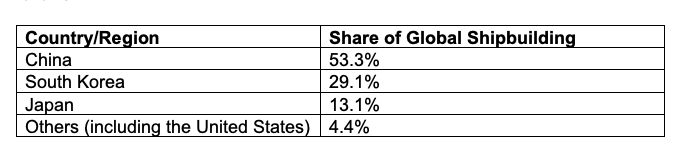
Within the challenges, we can identify opportunities and strategies to support the restoration of U.S. shipbuilding and maintenance, all of which impact Washington State.
In Washington and nationally, the following high-level opportunities must be addressed:
Technological modernization & innovation – marine fuels, autonomous vessels, AI, and additive manufacturing.
Rebuild industrial infrastructure.
Workforce development – a commitment to advanced training to include AI, robotics, nuclear welding and materials fabrication; expanding and strengthening community and technical college programs and apprenticeship.
Emerging markets - autonomous systems and vessels, marine fuels, AI and tracking technologies.
Strategic investments – contracts, long-term funding, financial incentives and collaboration across the public and private industry, government and education.
Supply Chain & Manufacturing - Distributed and modular construction – building vessel sections in various locations for assembly to improve efficiencies. Bringing the production of high-value components back to the United States.
Why This Matters
Shipbuilding is not only an industrial issue - it is a workforce, economic development, and national security imperative. Washington’s ability to sustain and grow its shipbuilding and repair capacity will directly influence the state’s maritime workforce pipeline, its role in national fleet readiness, and its long-term competitiveness in a rapidly changing global maritime landscape.
This context sets the stage for a focused, strategic Winter meeting conversation on shipbuilding, maritime fuels, and the workforce systems required to support both.