
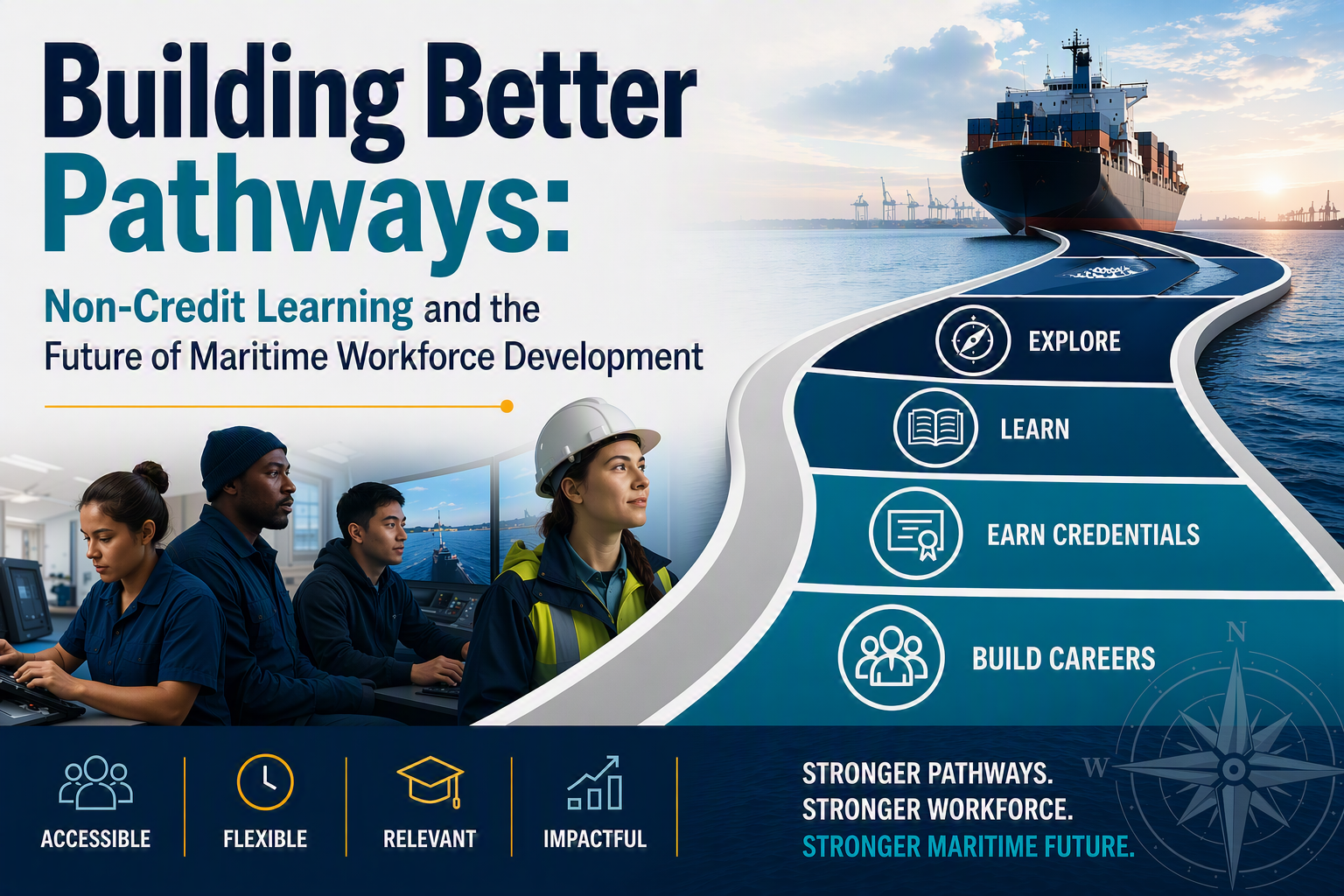
Building Better Pathways: Non-Credit Learning and the Future of Maritime Workforce Development
By Ann Avary, June 26, 2026
Whether the conversation is about vessel operations, shipbuilding and repair, marine technology, or the broader maritime industry, the message is the same: "We need more people."
Yet when we look closer, the issue isn't always a lack of interest. In many cases, it's a pathway problem.
We have built workforce systems that are often difficult to navigate, slow to respond, and heavily focused on traditional educational models that don't always reflect how people learn or enter careers today.
At a time when the maritime industry is facing unprecedented workforce shortages, we need to take a fresh look at how people gain skills, enter employment, and advance throughout their careers. That conversation must include non-credit learning.
Building better pathways is about more than meeting workforce demand. It is also about expanding opportunity. Flexible entry points into high-quality, family-wage maritime careers create opportunities for individuals and families to achieve long-term economic mobility while strengthening communities across Washington.
The challenge facing maritime workforce development today is not simply one of recruitment. It is a challenge of scale.
National conversations surrounding the White House Maritime Action Plan and Maritime Industrial Base workforce initiatives have reinforced what many of us have been saying for years: we cannot build maritime capacity without building workforce capacity. The demand for skilled workers across vessel operations, shipbuilding and repair, marine technology, and related sectors is growing at a pace and scale our existing workforce systems were never designed to support.
That does not diminish the importance of traditional credit-bearing education. Community and technical colleges, apprenticeship programs, and four-year institutions remain essential to developing the next generation of maritime professionals. The reality, however, is that these pathways alone cannot produce the volume of workers now needed within the timeframes industry is facing.
This is where non-credit learning becomes an important part of a more connected workforce system. Short-term, industry-responsive training can expand capacity, create additional on-ramps into maritime careers, and provide opportunities for individuals to continue advancing through credit-bearing education, apprenticeships, and stackable credentials over time. The goal is not to replace traditional education, but to build a workforce system that is flexible enough to meet both today's workforce demands and tomorrow's career opportunities.
The Missing Middle
In workforce development, we spend a great deal of time talking about K-12 education, college degrees, and employment outcomes.
What we sometimes overlook is everything in between. That "missing middle" is where much of today's workforce development actually occurs. It is where students explore careers, incumbent workers learn new technologies, veterans transition into civilian employment, and individuals gain the skills and confidence to take the next step. Non-credit learning often occupies this space, yet it is frequently treated as a secondary component of the workforce system rather than a foundational one.
The Pathway Isn't Always a Path
One of the things I hear most often from employers is that they need skilled technicians now. At the same time, many of the individuals we are trying to serve are working adults, parents, veterans, career changers, or students who simply cannot commit to a traditional one- or two-year program.
For these learners, the pathway often looks less like a straight line and more like a maze.
A person may complete a short-term training program but struggle to connect it to a college pathway. Another may earn valuable industry credentials that are not formally recognized within the education system. Still another may gain significant skills through military service, work experience, or employer training only to discover they must start over to earn a credential.
We call these pathways, but too often they are disconnected segments rather than connected routes.
The Credit Versus Non-Credit Debate Misses the Point
One of the things I’ve learned through years of working with employers is that they rarely ask whether a skill was learned in a credit or non-credit environment.
For years, we've treated credit and non-credit learning as though they exist in separate worlds. From a learner's perspective, that distinction often makes very little sense. Most people are simply looking for a way to gain skills, find a good job, and continue advancing throughout their careers.
What maritime employers want to know is simple:
Can the individual do the work?
Can they work safely?
Can they solve problems?
Can they contribute to the team?
Some of the most effective workforce programs I've seen operate outside traditional credit structures. They include pre-apprenticeships, boot camps, incumbent worker training, industry certifications, workforce-funded cohorts, and employer-led training programs.
These programs are often faster, more flexible, and more responsive to changing workforce needs. That doesn't make them better than credit programs. It makes them different, and equally important.
Washington State as a Maritime Campus
The concept of Washington State as a Maritime Campus is built on a simple idea: learning happens everywhere. It happens in high schools, community and technical colleges, apprenticeship programs, nonprofit organizations, on training vessels, in shipyards, at ports, and on working waterfronts. In many ways, Washington already functions as a maritime campus through a distributed network of education, industry, labor, and community partners that collectively prepare the next generation of maritime professionals. Recognizing, connecting, and strengthening this interconnected system expands access to maritime careers, strengthens workforce capacity, and creates more opportunities for individuals to build family-wage careers and long-term economic mobility through lifelong learning.
A workforce ecosystem is not a single institution or program. It is the network of education, industry, labor, workforce development, government, and community organizations that collectively prepare, connect, and advance the workforce.
The challenge is not creating more learning opportunities. It is connecting them into a workforce ecosystem that learners can successfully navigate.
Critical to this work is the role of employers. Throughout the maritime industry, employers consistently tell us they need more people and more pathways. They need workers who can demonstrate competency, work safely, solve problems, and contribute to the team. They are often less concerned with where learning occurred than whether an individual is prepared to succeed on the job.
For Washington State as a Maritime Campus to fully realize its potential, employers must continue to help validate skills, inform pathway development, and communicate workforce needs. Building workforce capacity at the scale required by the Maritime Action Plan and Maritime Industrial Base will require stronger alignment between industry, education, labor, workforce development, and community partners. Employers have a critical role to play in helping connect those systems.
Success should not be determined by where learning occurs. Success should be determined by whether learning leads to opportunity.
What We're Learning from Maritime Workforce Development
The good news is that we don't have to start from scratch. Across Washington State, there are already examples demonstrating how more connected, flexible workforce pathways can be built. These efforts offer practical models for expanding capacity while strengthening connections between education and industry.
MAC Welding & Fabrication Project
The MAC Welding & Fabrication Project offers one example of how non-credit learning, faculty development, and pathway alignment can work together to expand workforce capacity. As we've worked with employers, educators, and workforce partners across Washington, one message has remained consistent: learners need more flexible ways to enter maritime careers while preserving opportunities to continue advancing through education and training.
That work has led us to explore several strategies for strengthening workforce capacity and improving pathway connections, including:
Piloting a non-credit training cohort as a proof of concept.
Developing faculty-facing resources to strengthen welding and fabrication pathways.
Establishing a cohort-based professional development model for welding educators.
Supporting expanded statewide welding and fabrication education and training capacity.
While these efforts are centered on welding and fabrication, the lessons extend well beyond a single occupation. They demonstrate how flexible, industry-responsive training can complement traditional education while expanding access, increasing workforce capacity, and creating clearer pathways for learners to advance throughout their careers.
The same is true across the maritime industry. Whether we're talking about welding, vessel operations, marine technology, or shipbuilding and repair, employers consistently tell us they need multiple entry points into maritime careers. Learners come with different experiences, goals, and circumstances, and not every journey begins in the same place. Just as importantly, not every pathway needs to begin with a traditional degree program. Expanding opportunities for non-credit learning, industry training, and other flexible entry points allows more people to enter the workforce while creating opportunities to continue their education and advance throughout their careers.
In many parts of the maritime industry, employers don't necessarily need someone with a two-year degree to fill an immediate workforce need. They need an entry-level welder, a marine electrician trainee, an unlicensed mariner, a composites technician, or an individual prepared to enter a registered apprenticeship.
Non-credit programs can often provide those foundational skills more quickly and at lower cost while still creating opportunities for learners to continue into credit-bearing programs later.
Expanding Access to Underway Careers
Another area where broken pathways are particularly visible is underway maritime training.
Across the maritime industry, employers continue to express concerns about the availability of qualified mariners. From tug and towing operators to passenger vessel operators, ferries, commercial fishing fleets, government vessels, and oceangoing shipping, workforce demand remains strong. Yet for many prospective mariners, entering the industry can be difficult to understand and even more difficult to navigate. Unlike many industries, maritime careers also require navigating a series of regulatory and credentialing requirements that can be challenging for new entrants.
Underway careers often require a combination of classroom instruction, hands-on training, sea-time accumulation, medical examinations, drug testing, background checks, Merchant Mariner Credential (MMC) and a Transportation Worker Identification Credential (TWIC). While each requirement serves an important purpose, the cumulative effect can create a system that feels fragmented and inaccessible to new entrants.
For youth, career changers, veterans, and working adults, the traditional educational model does not always align with the realities of entering the maritime workforce. Many individuals are looking for opportunities to explore the industry, gain foundational skills, and determine whether a maritime career is the right fit before committing to a longer educational pathway.
This is where non-credit learning can play a critical role. Introductory vessel operations programs, maritime boot camps, deckhand training, safety certifications, simulator-based learning, and other short-term training opportunities can provide meaningful entry points into the industry. These experiences allow learners to gain exposure, build confidence, develop foundational competencies, and begin understanding the credentialing process without requiring an immediate commitment to a multi-year program.
These programs are not intended to replace credit-bearing education. Rather, they serve as on-ramps that help learners enter the maritime workforce and continue advancing toward higher-level credentials and careers.
One of the most significant barriers remains access to underway training opportunities and the sea time required for credential advancement. As an industry, we should be asking whether there are additional ways to create structured, accessible, and affordable opportunities for individuals to gain practical experience while progressing toward professional credentials.
Efforts such as the Vessel Operations Framework, developed by the Northwest Maritime Center, currently under review by OSPI and the broader vision of Washington State as a Maritime Campus provide an opportunity to rethink how individuals access maritime careers. Learning can occur in classrooms, on vessels, through apprenticeships, in community-based programs, and through non-credit workforce training. The key is ensuring those experiences are connected rather than isolated.
These efforts reflect a broader shift toward creating multiple entry points into maritime careers while ensuring those entry points remain connected to continued education, credential attainment, and career advancement.
Rather than focusing on whether someone begins in a credit or non-credit environment, we should be asking a different question: Have we built a system that allows people to enter, progress, and continue advancing throughout their careers?
The maritime industry provides a strong example of what that ecosystem can look like. Individuals may begin through a high school maritime program, a non-credit vessel operations course, an apprenticeship, a community or technical college, military service, or employer-sponsored training. Each represents a valuable entry point into the industry. What matters is not where someone starts, but whether those experiences are connected in ways that allow learners to build additional skills, earn credentials, transition into employment, and continue advancing over time.
Ultimately, the goal is not to create a single pathway. It is to create a connected workforce ecosystem with multiple entry points, clear opportunities for advancement, and the flexibility to meet learners where they are while responding to the evolving needs of employers.
A Significant Opportunity for Community and Technical Colleges
This shift represents a significant opportunity for community and technical colleges.
For decades, community and technical colleges have served as the backbone of workforce education, providing both academic pathways and career-focused training that respond directly to industry needs. As workforce shortages continue to grow across vessel operations, shipbuilding and repair, marine technology, manufacturing, and other maritime sectors, colleges are uniquely positioned to help close the gap.
Non-credit learning provides an opportunity for colleges to expand access, increase responsiveness, and serve learners who may not be ready or able to enter traditional academic programs. As workforce demands continue to accelerate, that opportunity extends beyond delivering programs to serving as connectors within the broader maritime workforce system.
For many learners, particularly working adults, veterans, career changers, and first-generation college students, these flexible entry points can remove barriers to education while opening doors to careers that offer family-sustaining wages and long-term advancement. In that way, pathway development is not simply a workforce development strategy; it is also an economic mobility strategy.
This is central to the vision of Washington State as a Maritime Campus. Community and technical colleges are uniquely positioned to serve as critical hubs within a connected statewide network that also includes K–12 education, apprenticeship programs, employers, labor organizations, ports, nonprofit organizations, and community-based partners. Together, these organizations expand access to maritime careers by providing multiple entry points, stackable learning opportunities, and connected pathways that support lifelong learning while responding to the workforce needs of industry.
In many ways, the future of maritime workforce development will depend not only on creating more pathways, but on the institutions that can connect them. Community and technical colleges are exceptionally well positioned to lead that work.
The Challenges Ahead
The future of maritime workforce development will depend on how well we connect learning rather than where learning occurs. Credit and non-credit education are not competing systems. They are complementary parts of a broader workforce ecosystem. If we are serious about building maritime workforce capacity at the scale now required, we must strengthen both and ensure learners can move between them throughout their careers.
Building better pathways is about more than meeting industry demand. It is about creating a workforce system that expands opportunity, supports lifelong learning, strengthens communities, and enables more individuals and families to achieve long-term economic mobility through meaningful careers.
The question is no longer whether non-credit learning belongs in the maritime workforce ecosystem. The question is whether we can afford to leave it out.