
Washington State as a Maritime Campus, Part III
By Ann Avary
Introduction
Washington’s maritime economy is one of the most diverse and dynamic in the United States. From shipbuilding and vessel operations to recreational boat building, commercial fishing and seafood processing, marine technology, logistics, and emerging ocean industries, the sector supports more than 170,000 jobs and generates approximately $46 billion in economic activity statewide.
And like much of the nation’s maritime industry, Washington faces a growing workforce challenge.
Shipbuilding expansion alone will require a significant increase in skilled workers. In remarks reported in Naval News on January 14, 2026, Secretary of the Navy John Phelan noted that U.S. shipbuilders and suppliers may need to hire approximately 250,000 skilled workers over the next decade to meet projected demand.
Two hundred fifty thousand workers is a staggering number, and it highlights the scale of the workforce challenge facing the maritime sector.
Meeting that demand will require more than expanding individual training programs. It will require thinking about maritime workforce development as a system - one that connects education, industry, and communities in ways that expand opportunity while aligning training with real workforce needs.
This article builds on the broader discussion of viewing Washington State as a connected maritime campus introduced in two earlier pieces.
Part I introduced the concept of thinking about Washington as a single maritime campus—an interconnected network of education programs, training providers, and industry partners working together to support the maritime workforce by delivering maritime content and career awareness to students and communities statewide.
Part II examined how that idea begins to take shape through regional partnerships, shared frameworks, and collaborative workforce initiatives already underway across the state.
This article focuses on the next step: how that model can scale.
Over the past year, with my colleague Dale Bateman of Seattle Maritime Academy, I’ve been assessing how Washington can function as a connected and geographically distributed maritime campus, supporting increased resilience and diverse technical talent pools.
Not a single new institution.
Not a geographically centralized program.
The model is a connected statewide system that brings maritime education, and industry-aligned training for both shoreside and underway careers - directly to communities across Washington.
A critical component of this approach is meeting students where they are, mitigating access barriers.
Rather than expecting students to relocate to the limited number of existing maritime programs, the Maritime Campus model focuses on bringing maritime industry content into existing educational pathways across the state.
In that sense, Washington’s maritime workforce pipeline does not begin at the shoreline—it begins in classrooms and training programs across the state.
And at its core, the idea is simple: The maritime campus is not a place - it is a system.
It connects classrooms, labs, industry partners, and regional workforce initiatives across Washington into a distributed network capable of preparing the next generation of maritime workers.
The Vision
Washington is home to a number of excellent maritime education and training programs that serve the industry. However, they are not evenly distributed across the state.
Most programs that directly support maritime careers—whether public, private, or nonprofit—are concentrated in the Puget Sound region, Northwest Counties and extending to the Olympic Peninsula, where much of the state’s maritime industry operates.
Even within those regions, the number of programs remains limited.
For many communities across Washington—particularly in rural regions, eastern Washington, and along the Columbia River corridor—access to maritime career education remains limited or nonexistent despite the presence of significant inland maritime activity.
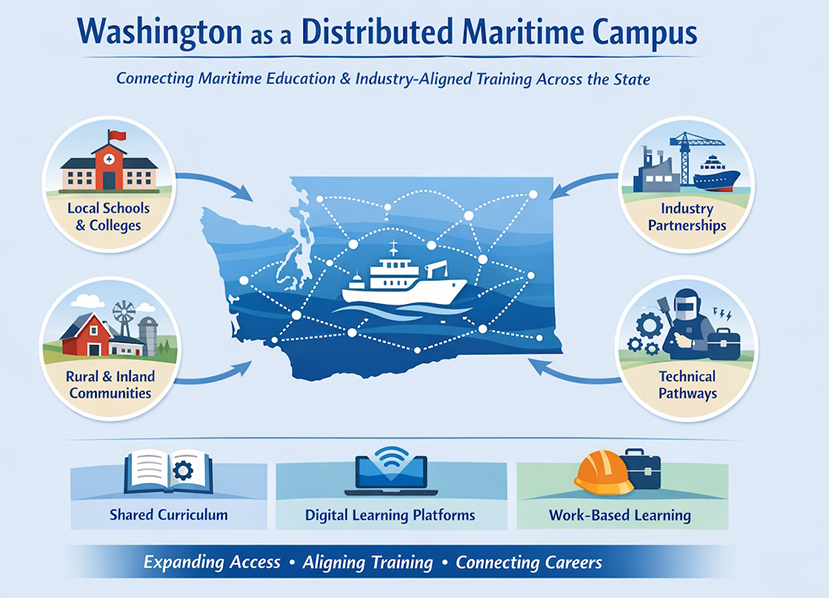
Rather than attempting to stand up full maritime programs in every community - which is economically and logistically unrealistic - the Maritime Campus concept focuses on delivering maritime content directly to communities through partnerships, shared frameworks, and distributed training approaches.
Through this approach, communities do not need to build a complete maritime program in order to participate in the maritime workforce pipeline.
Instead, they can integrate industry-aligned maritime content into existing technical programs - including welding, diesel technology, electrical systems, robotics, engineering, safety, and other career pathways.
In this way, Washington begins to function as a distributed maritime campus, where maritime education and workforce content can reach communities far beyond the locations where maritime programs are currently concentrated.
Why Maritime Pathways Matter Beyond the Puget Sound and Coastal Communities
While much of Washington’s maritime industry is concentrated in the Puget Sound region, the Olympic Peninsula and Northwest Counties, the economic footprint of the maritime sector extends far beyond these regions.
Maritime activity connects directly to industries and infrastructure throughout the state. The Columbia River system, for example, is one of the most important inland maritime transportation corridors in the United States, supporting the movement of agricultural products, manufactured goods, and bulk commodities between inland communities and global markets.
Many of the technical skills that support the maritime industry—welding, electrical systems, diesel technology, advanced manufacturing, robotics, and emerging marine technologies—are also foundational skills used across multiple sectors of Washington’s economy.
This overlap creates an important opportunity.
By integrating maritime applications and industry standards into existing technical programs, communities that are not located near shipyards or ports can still participate in the maritime workforce pipeline.
Students studying welding, fabrication, electrical systems, diesel technology, or advanced manufacturing in inland or rural communities can develop skills that are directly relevant to maritime employers while also supporting industries closer to home.
This approach expands access to maritime careers while strengthening the broader technical workforce across the state.
And given the scale of national workforce demand—the 250,000 workers projected for shipbuilding and related industries—expanding the reach of technical training pipelines will be essential.
A System in Action: The MAC Welding Project
One example of this distributed approach in practice is the MAC Welding & Fabrication Model Framework Project.
Welding is a foundational skill that supports multiple industries—maritime, construction, advanced manufacturing, agriculture, infrastructure, and energy. Yet welding programs have historically developed independently across regions, often resulting in variation in entry-level skills and employer expectations.
The MAC framework was designed to address that challenge.
Rather than creating new programs, the project focuses on aligning the programs that already exist through shared instructional frameworks, faculty collaboration, and industry-informed standards.
Through regional hubs and collaboration with educators and employers, welding instruction can become more connected across K–12 programs, community and technical colleges, apprenticeship programs, and industry training initiatives.
The result is the development of a statewide instructional infrastructure that supports greater access to industry-aligned training while reducing workforce skill variation.
Projects like MAC demonstrate how Washington can operate as a distributed maritime campus—where shared frameworks and collaborative systems allow workforce education to scale across regions while maintaining consistent standards.
Building Systems That Scale
One of the most important lessons emerging from this work is that scalability must be built into the system from the beginning.
Workforce initiatives often succeed locally but struggle to expand because they rely on individual programs or isolated investments.
The Maritime Campus model focuses instead on building shared infrastructure that allows innovation and access to spread across regions.
These systems include:
• Open-source curriculum frameworks
• Digital learning platforms
• Faculty professional development networks
• Industry advisory collaboration
• Data and evaluation systems
When these systems are connected, workforce development becomes more than a collection of programs.
It becomes a learning network capable of adapting to industry needs and expanding opportunity statewide.
What Implementation Looks Like Over the Next Five Years
Implementation of the Maritime Campus model focuses on strengthening the systems that connect existing programs.
Over the next five years, priorities include:
• Strengthening regional education and workforce hubs
• Expanding career pathways from middle school through apprenticeships and postsecondary training
• Investing in faculty professional development
• Aligning curriculum with industry standards
• Expanding open resource platforms
• Strengthening industry advisory partnerships and work-based learning opportunities
A key strategy will be bringing maritime industry content directly to communities across Washington, embedding maritime applications into existing education pathways rather than attempting to build full maritime programs everywhere.
What This Means for the National Maritime Workforce
The workforce challenges facing Washington’s maritime sector are not unique.
Across the United States, shipyards, vessel operators, marine manufacturers, ports, and maritime service companies are confronting the same pressures—an aging workforce, growing demand for skilled labor, rapidly evolving technologies, and the workforce imperatives outlined in the White House Maritime Action Plan released in February 2026.
Meeting that demand will require workforce systems that are more coordinated, more responsive to industry needs, and capable of operating at scale.
The maritime campus model offers one possible approach.
By aligning education programs through shared frameworks, faculty collaboration, and industry engagement, regions can strengthen training quality while expanding access to maritime careers.
A Model That Can Extend Beyond Washington
What is emerging in Washington may also offer lessons for the broader maritime workforce system in the United States.
Across the country, maritime employers face similar workforce pressures: an aging workforce, growing shipbuilding demand, evolving marine technologies, and limited access to training in many regions. Expanding capacity through traditional program expansion alone may not be sufficient to meet the scale of demand.
The distributed maritime campus approach offers another possibility—one that focuses on connecting and aligning existing education programs through shared frameworks, faculty collaboration, and industry partnerships rather than attempting to build new standalone institutions in every location.
If successful, the model developing in Washington could demonstrate how states and regions can expand maritime workforce capacity by linking existing education infrastructure into coordinated workforce networks capable of operating at scale.
The Work Ahead
Building a maritime campus is not a single project.
It is an ongoing effort to strengthen connections between people, programs, and opportunity.
At its core, the Maritime Campus concept is about access—ensuring that maritime opportunity reaches students wherever they live by bringing maritime education directly to communities rather than expecting communities to come to it.
Washington is not simply building maritime programs.
Washington is building a distributed maritime workforce system designed to power the industry for generations to come.
Sources
Washington Maritime Federation. Washington Maritime Industry Economic Impact Study.
Remarks by Secretary of the Navy John Phelan reported in Naval News, January 14, 2026.
The White House. Maritime Action Plan. February 2026.